Fundamentals Package
The MTConnect Standard defines the normative information model and protocol for retrieving information from manufacturing equipment. This document specifies the agentsoftware that collects data published from one or more piece(s) of equipment, organizes that data in a structured manner, and responds to requests for data from client software systems by providing a structured response in the form of a response document that is constructed using the semantic data model of a Standard. behavior and protocol.
Agent
The MTConnect Standard specifies the minimum functionality of the agentsoftware that collects data published from one or more piece(s) of equipment, organizes that data in a structured manner, and responds to requests for data from client software systems by providing a structured response in the form of a response document that is constructed using the semantic data model of a Standard. . The functionality is as follows:
- Provides store and forward messaging middleware service.
- Provides key-value information storage and asset retrieval service.
- Implements the REST API for the MTConnect Standard (See
REST Protocol).- DeviceComponent not belonging to any Component that may have assets metadata.
- observationsobserved value of a property at a point in time. collected by the agent.
- assetsitem, thing or entity that has potential or actual value to an organization. ISO 55000:2014 > Note 1 to entry: Value can be tangible or intangible, financial or non-financial, and includes consideration of risks and liabilities. It can be positive or negative at different stages of the asset life. > Note 2 to entry: Physical assets usually refer to equipment, inventory and properties owned by the organization. Physical assets are the opposite of intangible assets, which are non-physical assets such as leases, brands, digital assets, use rights, licences, intellectual property rights, reputation or agreements. > Note 3 to entry: A grouping of assets referred to as an asset system could also be considered as an asset. collected by the agent.
There are three types of information stored by an agentsoftware that collects data published from one or more piece(s) of equipment, organizes that data in a structured manner, and responds to requests for data from client software systems by providing a structured response in the form of a response document that is constructed using the semantic data model of a Standard. that MAY be published in a response documentelectronic document published by an MTConnect Agent in response to a probe request, current request, sample request or asset request.. These are as follows:
- equipment metadatametadata that defines both the entities that represent the physical and logical parts and sub-parts of each piece of equipment, the relationships between those parts and sub-parts, and the definitions of the DataItems associated with that piece of equipment. specified in
Device Information Model. - streaming dataobservations published by a piece of equipment defined by the equipment metadata. provides the observationsobserved value of a property at a point in time. specified in
Observation Information Model. - Assetsasset that is used by the manufacturing process to perform tasks. > Note 1 to entry: An Asset relies upon an Device to provide observations and information about itself and the Device revises the information to reflect changes to the Asset during their interaction. Examples of Assets are cutting tools, Part Information, Manufacturing Processes, Fixtures, and Files. > Note 2 to entry: A singular
assetId,Assetuniquely identifies an Asset throughout its lifecycle and is used to track and relate the Asset to other Devices and entities. > Note 3 to entry: Assets are temporally associated with a device and can be removed from the device without damage or alteration to its primary functions. specified inAsset Information Model.
Agent Instance ID
The agentsoftware that collects data published from one or more piece(s) of equipment, organizes that data in a structured manner, and responds to requests for data from client software systems by providing a structured response in the form of a response document that is constructed using the semantic data model of a Standard. MUST set the instanceId to a unique value whenever the sequence numberprimary key identifier used to manage and locate a specific piece of streaming data in an agent. in the agent is initialized to 1. (see Section Sequence Numbers and Section Persistence and Recovery below).
Storage of Equipment Metadata
An agentsoftware that collects data published from one or more piece(s) of equipment, organizes that data in a structured manner, and responds to requests for data from client software systems by providing a structured response in the form of a response document that is constructed using the semantic data model of a Standard. MUST be capable of publishing equipment metadatametadata that defines both the entities that represent the physical and logical parts and sub-parts of each piece of equipment, the relationships between those parts and sub-parts, and the definitions of the DataItems associated with that piece of equipment. for the agentsoftware that collects data published from one or more piece(s) of equipment, organizes that data in a structured manner, and responds to requests for data from client software systems by providing a structured response in the form of a response document that is constructed using the semantic data model of a Standard. as specified in Device Information Model.
Storage of Streaming Data
The agentsoftware that collects data published from one or more piece(s) of equipment, organizes that data in a structured manner, and responds to requests for data from client software systems by providing a structured response in the form of a response document that is constructed using the semantic data model of a Standard. MAY implement a buffersection of an agent that provides storage for information published from pieces of equipment. with a fixed number of observationsobserved value of a property at a point in time.. If the bufferSize is fixed, the agentsoftware that collects data published from one or more piece(s) of equipment, organizes that data in a structured manner, and responds to requests for data from client software systems by providing a structured response in the form of a response document that is constructed using the semantic data model of a Standard. MUST store observationsobserved value of a property at a point in time. using a first-in-first-out pattern. The agentsoftware that collects data published from one or more piece(s) of equipment, organizes that data in a structured manner, and responds to requests for data from client software systems by providing a structured response in the form of a response document that is constructed using the semantic data model of a Standard. will remove the oldest observationobserved value of a property at a point in time. when the buffersection of an agent that provides storage for information published from pieces of equipment. is full and a new observationobserved value of a property at a point in time. arrives.

In Figure first-in-first-out-buffer-management, the maximum number of observationsobserved value of a property at a point in time. that can be stored in the buffersection of an agent that provides storage for information published from pieces of equipment. of the agentsoftware that collects data published from one or more piece(s) of equipment, organizes that data in a structured manner, and responds to requests for data from client software systems by providing a structured response in the form of a response document that is constructed using the semantic data model of a Standard. is 8. The bufferSize in the header reports the maximum number of observationsobserved value of a property at a point in time.. This example illustrates that when the buffersection of an agent that provides storage for information published from pieces of equipment. fills up, the oldest piece of data falls out the other end.

Note: As an implementation suggestion, the buffersection of an agent that provides storage for information published from pieces of equipment. should be sized large enough to provide a continuous stream of observationsobserved value of a property at a point in time.. The implementer should also consider the impact of a temporary loss of communications when determining the size for the buffersection of an agent that provides storage for information published from pieces of equipment.. A larger buffersection of an agent that provides storage for information published from pieces of equipment. will allow more time to reconnect to an agentsoftware that collects data published from one or more piece(s) of equipment, organizes that data in a structured manner, and responds to requests for data from client software systems by providing a structured response in the form of a response document that is constructed using the semantic data model of a Standard. without losing data.
Sequence Numbers
In an agentsoftware that collects data published from one or more piece(s) of equipment, organizes that data in a structured manner, and responds to requests for data from client software systems by providing a structured response in the form of a response document that is constructed using the semantic data model of a Standard. , each occurrence of an observationobserved value of a property at a point in time. in the buffersection of an agent that provides storage for information published from pieces of equipment. will be assigned a monotonically increasing unsigned 64-bit integer (sequence numberprimary key identifier used to manage and locate a specific piece of streaming data in an agent.) when it arrives. The first sequence numberprimary key identifier used to manage and locate a specific piece of streaming data in an agent. MUST be 1.
The sequence numberprimary key identifier used to manage and locate a specific piece of streaming data in an agent. for each observationobserved value of a property at a point in time. MUST be unique for an instance of an agentsoftware that collects data published from one or more piece(s) of equipment, organizes that data in a structured manner, and responds to requests for data from client software systems by providing a structured response in the form of a response document that is constructed using the semantic data model of a Standard. identified by an instanceId.
Table instanceid-and-sequence illustrates the changing of the instanceId when an agentsoftware that collects data published from one or more piece(s) of equipment, organizes that data in a structured manner, and responds to requests for data from client software systems by providing a structured response in the form of a response document that is constructed using the semantic data model of a Standard. resets the sequence numberprimary key identifier used to manage and locate a specific piece of streaming data in an agent. to 1.
instanceId | sequence |
|---|---|
| 234556 | 234 |
| 235 | |
| 236 | |
| 237 | |
| 238 | |
| Agent Stops and Restarts | |
| 234557 | 1 |
| 2 | |
| 3 | |
| 4 | |
| 5 |
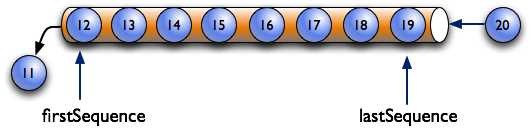
Figure identifying-the-range-of-data-with-firstsequence-and-lastsequence shows two additional pieces of information defined for an agentsoftware that collects data published from one or more piece(s) of equipment, organizes that data in a structured manner, and responds to requests for data from client software systems by providing a structured response in the form of a response document that is constructed using the semantic data model of a Standard. :
firstSequence– the oldest observationobserved value of a property at a point in time. in the buffersection of an agent that provides storage for information published from pieces of equipment.. The agentsoftware that collects data published from one or more piece(s) of equipment, organizes that data in a structured manner, and responds to requests for data from client software systems by providing a structured response in the form of a response document that is constructed using the semantic data model of a Standard. removes this observationobserved value of a property at a point in time. when it receives the next observationobserved value of a property at a point in time.lastSequence– the newest observationobserved value of a property at a point in time. in the buffersection of an agent that provides storage for information published from pieces of equipment.
firstSequence and lastSequence provide the range of values for the REST API requests.
The agentsoftware that collects data published from one or more piece(s) of equipment, organizes that data in a structured manner, and responds to requests for data from client software systems by providing a structured response in the form of a response document that is constructed using the semantic data model of a Standard. MUST begin evaluating observationsobserved value of a property at a point in time. with sample requestrequest to an agent to produce an MTConnectStreams Response Document containing the Observation Information Model for a set of timestamped observations made by Components.’s from parameter. Also, the agentsoftware that collects data published from one or more piece(s) of equipment, organizes that data in a structured manner, and responds to requests for data from client software systems by providing a structured response in the form of a response document that is constructed using the semantic data model of a Standard. MUST include a maximum number of observationsobserved value of a property at a point in time. given by the count parameter in the response documentelectronic document published by an MTConnect Agent in response to a probe request, current request, sample request or asset request..
In Figure identifying-the-range-of-data-with-from-and-count, the request specifies the observationsobserved value of a property at a point in time. start at sequence numberprimary key identifier used to manage and locate a specific piece of streaming data in an agent. 15 (from) and includes a total of three items (count).
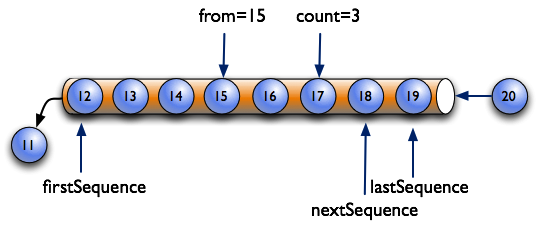
nextSequence header property has the sequence numberprimary key identifier used to manage and locate a specific piece of streaming data in an agent. of the next observationobserved value of a property at a point in time. in the buffersection of an agent that provides storage for information published from pieces of equipment. for subsequent sample requestsrequest to an agent to produce an MTConnectStreams Response Document containing the Observation Information Model for a set of timestamped observations made by Components. providing a contiguous set of observationsobserved value of a property at a point in time.. In the example in Figure identifying-the-range-of-data-with-from-and-count, the next sequence numberprimary key identifier used to manage and locate a specific piece of streaming data in an agent. (nextSequence) will be 18.
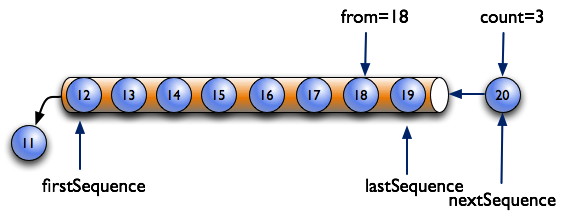
As shown in Figure identifying-the-range-of-data-with-nextsequence-and-lastsequence, the combination of from and count defined by the requestcommunications method where a client transmits a message to an agent. That message instructs the agent to respond with specific information. indicates a sequence numberprimary key identifier used to manage and locate a specific piece of streaming data in an agent. for data that is beyond that which is currently in the buffersection of an agent that provides storage for information published from pieces of equipment.. In this case, nextSequence is set to a value of \(lastSequence + 1\).
Observation Buffer
An observationobserved value of a property at a point in time. has four pieces of information as follows:
- sequence numberprimary key identifier used to manage and locate a specific piece of streaming data in an agent. associated with each observationobserved value of a property at a point in time. -
sequence. - The
timestampthe observationobserved value of a property at a point in time. was made. . - A reference to the
dataitemidfrom theDevice Information Model. - The value of the observationobserved value of a property at a point in time..
Table data-storage-concept is an example demonstrating the concept of how data may be stored in an agentsoftware that collects data published from one or more piece(s) of equipment, organizes that data in a structured manner, and responds to requests for data from client software systems by providing a structured response in the form of a response document that is constructed using the semantic data model of a Standard. :
sequence | timestamp | dataItemId | result |
|---|---|---|---|
101 | 2016-12-13T09:44:00.2221Z | AVAIL-28277 | UNAVAILABLE |
102 | 2016-12-13T09:54:00.3839Z | AVAIL-28277 | AVAILABLE |
103 | 2016-12-13T10:00:00.0594Z | POS-Y-28277 | 25.348 |
104 | 2016-12-13T10:00:00.0594Z | POS-Z-28277 | 13.23 |
105 | 2016-12-13T10:00:03.2839Z | SS-28277 | 0 |
106 | 2016-12-13T10:00:03.2839Z | POS-X-28277 | 11.195 |
107 | 2016-12-13T10:00:03.2839Z | POS-Y-28277 | 24.938 |
108 | 2016-12-13T10:01:37.8594Z | POS-Z-28277 | 1.143 |
109 | 2016-12-13T10:02:03.2617Z | SS-28277 | 1002 |
Timestamp
observationsobserved value of a property at a point in time. MUST have a timestamp giving the most accurate time that the observationobserved value of a property at a point in time. occurred.
The timezone of the timestamp MUST be UTC (Coordinated Universal Time) and represented using ISO 8601 format: e.g., “2010-04-01T21:22:43Z”.
Applications SHOULD use the observationobserved value of a property at a point in time.’s timestamp for ordering as opposed to sequence numberprimary key identifier used to manage and locate a specific piece of streaming data in an agent..
All observationsobserved value of a property at a point in time. occurring at the same time MUST have the same timestamp.
Recording Occurrences of Streaming Data
The agentsoftware that collects data published from one or more piece(s) of equipment, organizes that data in a structured manner, and responds to requests for data from client software systems by providing a structured response in the form of a response document that is constructed using the semantic data model of a Standard. MUST only place observationsobserved value of a property at a point in time. in the buffersection of an agent that provides storage for information published from pieces of equipment. if the data has changed from the previous observationobserved value of a property at a point in time. for the same DataItem.
The agentsoftware that collects data published from one or more piece(s) of equipment, organizes that data in a structured manner, and responds to requests for data from client software systems by providing a structured response in the form of a response document that is constructed using the semantic data model of a Standard. MUST place every observationobserved value of a property at a point in time. in the buffersection of an agent that provides storage for information published from pieces of equipment., without checking for changes, in the following cases:
- The
discreteattribute istruefor theDataItem. - The
representationisDISCRETE. - The
representationisTIME_SERIES.
Maintaining Last Value for Data Entities
An agentsoftware that collects data published from one or more piece(s) of equipment, organizes that data in a structured manner, and responds to requests for data from client software systems by providing a structured response in the form of a response document that is constructed using the semantic data model of a Standard. MUST retain the most recent observationobserved value of a property at a point in time. associated with each DataItem, even if the observationobserved value of a property at a point in time. is no longer in the buffersection of an agent that provides storage for information published from pieces of equipment.. This function supports the current requestrequest to an agent to produce an MTConnectStreams Response Document containing the Observation Information Model for a snapshot of the latest observations at the moment of the request or at a given sequence number. functionality.
Unavailability of Data
An observationobserved value of a property at a point in time. with the value of UNAVAILABLE indicates the value is indeterminate.
The agentsoftware that collects data published from one or more piece(s) of equipment, organizes that data in a structured manner, and responds to requests for data from client software systems by providing a structured response in the form of a response document that is constructed using the semantic data model of a Standard. MUST initialize every DataItem, unless it has a constant value (see below), with an observationobserved value of a property at a point in time. with the value of UNAVAILABLE. Aditionally, whenever the data source is unreachable, every DataItem associated with the data source must have an observationobserved value of a property at a point in time. with the value of UNAVAILABLE and timestamp when the connection was lost.
An DataItem that is constrained to a constant value, as defined in Device Information Model, MUST only have an observationobserved value of a property at a point in time. with the constant value and MUST NOT be set to UNAVAILABLE.
Persistence and Recovery
The agentsoftware that collects data published from one or more piece(s) of equipment, organizes that data in a structured manner, and responds to requests for data from client software systems by providing a structured response in the form of a response document that is constructed using the semantic data model of a Standard. MAY have a fixed size buffersection of an agent that provides storage for information published from pieces of equipment. and the buffersection of an agent that provides storage for information published from pieces of equipment. MAY be ephemeral.
If the buffersection of an agent that provides storage for information published from pieces of equipment. is recoverable, the agentsoftware that collects data published from one or more piece(s) of equipment, organizes that data in a structured manner, and responds to requests for data from client software systems by providing a structured response in the form of a response document that is constructed using the semantic data model of a Standard. MUST NOT change the instanceId and MUST NOT set the sequence numberprimary key identifier used to manage and locate a specific piece of streaming data in an agent. to 1. The sequence numberprimary key identifier used to manage and locate a specific piece of streaming data in an agent. MUST be one greater than the maximum value of the recovered observationsobserved value of a property at a point in time.. \(max(sequence) + 1\)
Storage of MTConnect Assets
An agentsoftware that collects data published from one or more piece(s) of equipment, organizes that data in a structured manner, and responds to requests for data from client software systems by providing a structured response in the form of a response document that is constructed using the semantic data model of a Standard. MAY only retain a limited number of Assets in the asset bufferbuffer for Assets.. The Assets are stored in first-in-first-out method where the oldest Asset is removed when the asset bufferbuffer for Assets. is full and a new Asset arrives.
Figure first-in-first-out-asset-buffer-management illustrates the oldest Asset being removed from the asset bufferbuffer for Assets. when a new Asset is added and the asset bufferbuffer for Assets. is full:

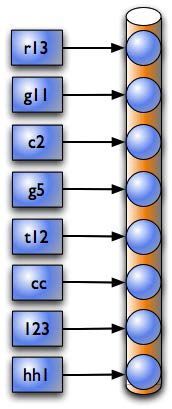
Assets are indexed by assetId. In the case of Assets, Figure relationship-between-assetid-and-stored-asset-documents demonstrates the relationship between the key (assetId) and the stored Asset:
Note: The key (
assetId) is independent of the order of theAssetstored in the asset bufferbuffer for Assets..
When the agentsoftware that collects data published from one or more piece(s) of equipment, organizes that data in a structured manner, and responds to requests for data from client software systems by providing a structured response in the form of a response document that is constructed using the semantic data model of a Standard. receives a new Asset, one of the following rules MUST apply:
If the
Assetis not in the asset bufferbuffer for Assets., the agentsoftware that collects data published from one or more piece(s) of equipment, organizes that data in a structured manner, and responds to requests for data from client software systems by providing a structured response in the form of a response document that is constructed using the semantic data model of a Standard. MUST add the newAssetto the front of the asset bufferbuffer for Assets.. If the asset bufferbuffer for Assets. is full, the oldestAssetwill be removed from the asset bufferbuffer for Assets..If the
Assetis already in the asset bufferbuffer for Assets., the agentsoftware that collects data published from one or more piece(s) of equipment, organizes that data in a structured manner, and responds to requests for data from client software systems by providing a structured response in the form of a response document that is constructed using the semantic data model of a Standard. MUST replace the existingAssetand move theAssetto the front of the asset bufferbuffer for Assets..
The number of Asset that may be stored in an agentsoftware that collects data published from one or more piece(s) of equipment, organizes that data in a structured manner, and responds to requests for data from client software systems by providing a structured response in the form of a response document that is constructed using the semantic data model of a Standard. is defined by the value for assetBufferSize. An assetBufferSize of 4,294,967,296 or \(2^{32 }\) MUST indicate unlimited storage.
The asset bufferbuffer for Assets. MAY be ephemeral and the Asset entities will be lost if the agentsoftware that collects data published from one or more piece(s) of equipment, organizes that data in a structured manner, and responds to requests for data from client software systems by providing a structured response in the form of a response document that is constructed using the semantic data model of a Standard. clears the asset bufferbuffer for Assets.. They must be recovered from the data source.
Asset Information Model provides additional information on assetitem, thing or entity that has potential or actual value to an organization. ISO 55000:2014 > Note 1 to entry: Value can be tangible or intangible, financial or non-financial, and includes consideration of risks and liabilities. It can be positive or negative at different stages of the asset life. > Note 2 to entry: Physical assets usually refer to equipment, inventory and properties owned by the organization. Physical assets are the opposite of intangible assets, which are non-physical assets such as leases, brands, digital assets, use rights, licences, intellectual property rights, reputation or agreements. > Note 3 to entry: A grouping of assets referred to as an asset system could also be considered as an asset. management.
Response Documents
response documentselectronic document published by an MTConnect Agent in response to a probe request, current request, sample request or asset request. are electronic documents generated by an agentsoftware that collects data published from one or more piece(s) of equipment, organizes that data in a structured manner, and responds to requests for data from client software systems by providing a structured response in the form of a response document that is constructed using the semantic data model of a Standard. in response to a requestcommunications method where a client transmits a message to an agent. That message instructs the agent to respond with specific information. for data.
The response documentselectronic document published by an MTConnect Agent in response to a probe request, current request, sample request or asset request. defined in the MTConnect Standard are:
MTConnectDevices Response Documentresponse document published by an MTConnect Agent in response to a probe request.: Describes the composition and configuration of the DeviceComponent not belonging to any Component that may have assets and the data that can be observed. See
MTConnectDevices Response DocumentandDevice Information Modelfor details on this information model.MTConnectStreams Response Documentresponse document published by an MTConnect Agent in response to a current request or a sample request.: Observationsobservation that provides telemetry data for a DataItem. made at a point in time about related DataItemsobservable observed by a Component that may make Observations. See
MTConnectStreams Response DocumentandObservation Information Modelfor details on this information model.MTConnectAssets Response Documentresponse document published by an MTConnect Agent in response to an asset request.: Assetsasset that is used by the manufacturing process to perform tasks. > Note 1 to entry: An Asset relies upon an Device to provide observations and information about itself and the Device revises the information to reflect changes to the Asset during their interaction. Examples of Assets are cutting tools, Part Information, Manufacturing Processes, Fixtures, and Files. > Note 2 to entry: A singular
assetId,Assetuniquely identifies an Asset throughout its lifecycle and is used to track and relate the Asset to other Devices and entities. > Note 3 to entry: Assets are temporally associated with a device and can be removed from the device without damage or alteration to its primary functions. related to DevicesComponent not belonging to any Component that may have assets. SeeMTConnectAssets Response DocumentandAsset Information Modelfor details on this information model.MTConnectErrors Response Documentresponse document published by an MTConnect Agent whenever it encounters an error while interpreting an MTConnect Request.: Information in response to a failed request. See
MTConnectErrors Response Documentfor details on this information model.
Request/Response Information Exchange
The transfer of information between an agentsoftware that collects data published from one or more piece(s) of equipment, organizes that data in a structured manner, and responds to requests for data from client software systems by providing a structured response in the form of a response document that is constructed using the semantic data model of a Standard. and a client software application is based on a request and responsecommunications pattern that supports the transfer of information between an agent and a client. REST protocol. A client application requests specific information from an agentsoftware that collects data published from one or more piece(s) of equipment, organizes that data in a structured manner, and responds to requests for data from client software systems by providing a structured response in the form of a response document that is constructed using the semantic data model of a Standard. and an agentsoftware that collects data published from one or more piece(s) of equipment, organizes that data in a structured manner, and responds to requests for data from client software systems by providing a structured response in the form of a response document that is constructed using the semantic data model of a Standard. responds with a response documentelectronic document published by an MTConnect Agent in response to a probe request, current request, sample request or asset request..
There are four types of MTConnect Requestsrequest for information issued from a client to an MTConnect Agent.. These requestscommunications method where a client transmits a message to an agent. That message instructs the agent to respond with specific information. are as follows:
probe requestrequest to an agent to produce an MTConnectDevices Response Document containing the Device Information Model.: Requests information about one more more DevicesComponent not belonging to any Component that may have assets as an
MTConnectDevicesblock.current requestrequest to an agent to produce an MTConnectStreams Response Document containing the Observation Information Model for a snapshot of the latest observations at the moment of the request or at a given sequence number.: Requests the most recent, or snapshot at a sequence numberprimary key identifier used to manage and locate a specific piece of streaming data in an agent., observationsobserved value of a property at a point in time. as an
MTConnectStreamsblock.sample requestrequest to an agent to produce an MTConnectStreams Response Document containing the Observation Information Model for a set of timestamped observations made by Components.: Requests a series of observationsobserved value of a property at a point in time. as an
MTConnectStreamsblock.asset requestHTTP Request to the agent regarding Assets.: Requests a set of assetsitem, thing or entity that has potential or actual value to an organization. ISO 55000:2014 > Note 1 to entry: Value can be tangible or intangible, financial or non-financial, and includes consideration of risks and liabilities. It can be positive or negative at different stages of the asset life. > Note 2 to entry: Physical assets usually refer to equipment, inventory and properties owned by the organization. Physical assets are the opposite of intangible assets, which are non-physical assets such as leases, brands, digital assets, use rights, licences, intellectual property rights, reputation or agreements. > Note 3 to entry: A grouping of assets referred to as an asset system could also be considered as an asset. as an
MTConnectAssetsblock.
If an agentsoftware that collects data published from one or more piece(s) of equipment, organizes that data in a structured manner, and responds to requests for data from client software systems by providing a structured response in the form of a response document that is constructed using the semantic data model of a Standard. is unable to respond to the request for information or the request includes invalid information, the agentsoftware that collects data published from one or more piece(s) of equipment, organizes that data in a structured manner, and responds to requests for data from client software systems by providing a structured response in the form of a response document that is constructed using the semantic data model of a Standard. will publish an MTConnectErrors Response Documentresponse document published by an MTConnect Agent whenever it encounters an error while interpreting an MTConnect Request.. See MTConnectErrors.
See REST Protocol for the details on the normative requirements of the agent.