Interface Interaction Model Package
In many manufacturing processes, multiple pieces of equipment must work together to perform a task. The traditional method for coordinating the activities between individual pieces of equipment is to connect them using a series of wires to communicate equipment states and demands for action. These interactions use simple binary ON/OFF signals to accomplished their intention.
In the MTConnect Standard, interfacesmeans by which communication is achieved between independent systems. provides a means to replace this traditional method for interconnecting pieces of equipment with a structured interaction modelmodel that defines how information is exchanged across an interface to enable interactions between independent systems. that provides a rich set of information used to coordinate the actions between pieces of equipment. Implementers may utilize the information provided by this data model to (1) realize the interaction between pieces of equipment and (2) to extend the functionality of the equipment to improve the overall performance of the manufacturing process.
The interaction modelmodel that defines how information is exchanged across an interface to enable interactions between independent systems. used to implement interfacesmeans by which communication is achieved between independent systems. provides a lightweight and efficient protocol, simplifies failure recovery scenarios, and defines a structure for implementing a Plug-And-Play relationship between pieces of equipment. By standardizing the information exchange using this higher-level semantic information model, an implementer may more readily replace a piece of equipment in a manufacturing system with any other piece of equipment capable of providing similar interaction modelmodel that defines how information is exchanged across an interface to enable interactions between independent systems. functions.
Two primary functions are required to implement the interaction modelmodel that defines how information is exchanged across an interface to enable interactions between independent systems. for an interfacesmeans by which communication is achieved between independent systems. and manage the flow of information between pieces of equipment. Each piece of equipment needs to have the following:
An agentsoftware that collects data published from one or more piece(s) of equipment, organizes that data in a structured manner, and responds to requests for data from client software systems by providing a structured response in the form of a response document that is constructed using the semantic data model of a Standard. which provides:
The data required to implement the interaction modelmodel that defines how information is exchanged across an interface to enable interactions between independent systems..
Any other data from a piece of equipment needed to implement the interfacemeans by which communication is achieved between independent systems. – operating states of the equipment, position information, execution modes, process information, etc.
A client software application that enables the piece of equipment to acquire and interpret information from another piece of equipment.
Interfaces Architecture
MTConnect Standard is based on a communications method that provides no direct way for one piece of equipment to change the state of or cause an action to occur in another piece of equipment. The interaction modelmodel that defines how information is exchanged across an interface to enable interactions between independent systems. used to implement interfacesmeans by which communication is achieved between independent systems. is based on a publish and subscribeasynchronous communication method in which messages are exchanged between applications without knowing the identity of the sender or recipient. > Note: In the MTConnect Standard, a communications messaging pattern that may be used to publish streaming data from an agent. type of communications as described in Fundamentals and utilizes a requestcommunications method where a client transmits a message to an agent. That message instructs the agent to respond with specific information. and responseresponse interface which responds to a request. information exchange mechanism. For interfacesmeans by which communication is achieved between independent systems., pieces of equipment must perform both the publish (agentsoftware that collects data published from one or more piece(s) of equipment, organizes that data in a structured manner, and responds to requests for data from client software systems by providing a structured response in the form of a response document that is constructed using the semantic data model of a Standard. ) and subscribe (client) functions.
Note: The current definition of interfacesmeans by which communication is achieved between independent systems. addresses the interaction between two pieces of equipment. Future releases of the MTConnect Standard may address the interaction between multiple (more than two) pieces of equipment.
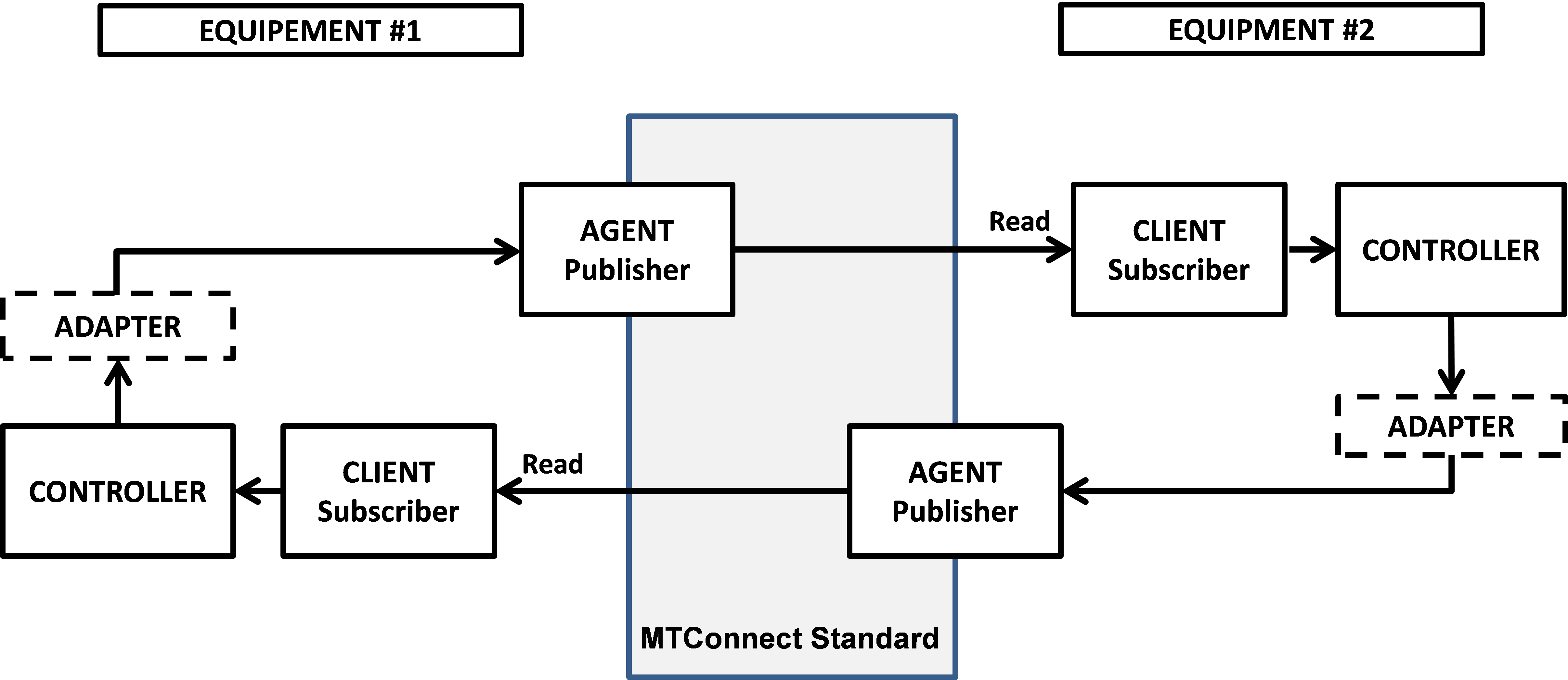
Note: The data flow architecture illustrated in Figure Data Flow Architecture for Interfaces was historically referred to in the MTConnect Standard as a read-read concept.
In the implementation of the interaction modelmodel that defines how information is exchanged across an interface to enable interactions between independent systems. for interfacesmeans by which communication is achieved between independent systems., two pieces of equipment can exchange information in the following manner. One piece of equipment indicates a requestcommunications method where a client transmits a message to an agent. That message instructs the agent to respond with specific information. for service by publishing a type of requestcommunications method where a client transmits a message to an agent. That message instructs the agent to respond with specific information. using a data item provided through an agentsoftware that collects data published from one or more piece(s) of equipment, organizes that data in a structured manner, and responds to requests for data from client software systems by providing a structured response in the form of a response document that is constructed using the semantic data model of a Standard. as defined in DataItem Types for Interface. The client associated with the second piece of equipment, which is subscribing to data from the first machine, detects and interprets that requestcommunications method where a client transmits a message to an agent. That message instructs the agent to respond with specific information.. If the second machine chooses to take any action to fulfill this requestcommunications method where a client transmits a message to an agent. That message instructs the agent to respond with specific information., it can indicate its acceptance by publishing a responseresponse interface which responds to a request. using a data item provided through its agentsoftware that collects data published from one or more piece(s) of equipment, organizes that data in a structured manner, and responds to requests for data from client software systems by providing a structured response in the form of a response document that is constructed using the semantic data model of a Standard. . The client on the first piece of equipment continues to monitor information from the second piece of equipment until it detects an indication that the responseresponse interface which responds to a request. to the requestcommunications method where a client transmits a message to an agent. That message instructs the agent to respond with specific information. has been completed or has failed.
An example of this type of interaction between pieces of equipment can be represented by a machine tool that wants the material to be loaded by a robot. In this example, the machine tool is the requesterentity that initiates a request for information in a communications exchange., and the robot is the responderentity that responds to a request for information in a communications exchange.. On the other hand, if the robot wants the machine tool to open a door, the robot becomes the requesterentity that initiates a request for information in a communications exchange. and the machine tool the responderentity that responds to a request for information in a communications exchange..
Request and Response Information Exchange
The DataItem elements defined by the interaction modelmodel that defines how information is exchanged across an interface to enable interactions between independent systems. each have a REQUEST and RESPONSE subtype. These subtypes identify if the data item represents a requestcommunications method where a client transmits a message to an agent. That message instructs the agent to respond with specific information. or a responseresponse interface which responds to a request.. Using these data items, a piece of equipment changes the state of its requestcommunications method where a client transmits a message to an agent. That message instructs the agent to respond with specific information. or responseresponse interface which responds to a request. to indicate information that can be read by the other piece of equipment. To aid in understanding how the interaction modelmodel that defines how information is exchanged across an interface to enable interactions between independent systems. functions, one can view this interaction modelmodel that defines how information is exchanged across an interface to enable interactions between independent systems. as a simple state machine.
The interaction between two pieces of equipment can be described as follows. When the requesterentity that initiates a request for information in a communications exchange. wants an activity to be performed, it transitions its requestcommunications method where a client transmits a message to an agent. That message instructs the agent to respond with specific information. state from a READY state to an ACTIVE state. In turn, when the client on the responderentity that responds to a request for information in a communications exchange. reads this information and interprets the requestcommunications method where a client transmits a message to an agent. That message instructs the agent to respond with specific information., the responderentity that responds to a request for information in a communications exchange. announces that it is performing the requested task by changing its response state to ACTIVE. When the action is finished, the responderentity that responds to a request for information in a communications exchange. changes its response state to COMPLETE. This pattern of requestcommunications method where a client transmits a message to an agent. That message instructs the agent to respond with specific information. and responseresponse interface which responds to a request. provides the basis for the coordination of actions between pieces of equipment. These actions are implemented using EVENT category data items. (See DataItem Types for Interface for details on the Event type data items defined for interfacesmeans by which communication is achieved between independent systems..)
Note: The implementation details of how the responderentity that responds to a request for information in a communications exchange. piece of equipment reacts to the requestcommunications method where a client transmits a message to an agent. That message instructs the agent to respond with specific information. and then completes the requested task are up to the implementer.
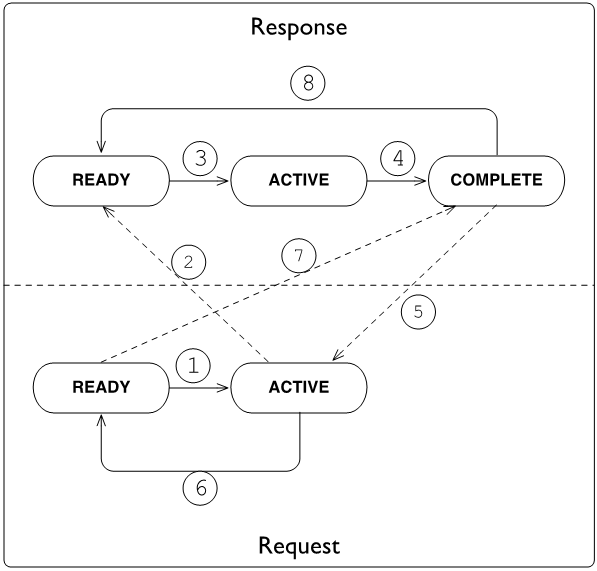
The initial condition of both the requestcommunications method where a client transmits a message to an agent. That message instructs the agent to respond with specific information. and responseresponse interface which responds to a request. states on both pieces of equipment is READY. The dotted lines indicate the on-going communications that occur to monitor the progress of the interactions between the pieces of equipment.
The interaction between the pieces of equipment as illustrated in Figure Request and Response Overview progresses through the sequence listed below.
The requestcommunications method where a client transmits a message to an agent. That message instructs the agent to respond with specific information. transitions from
READYtoACTIVEsignaling that a service is needed.The responseresponse interface which responds to a request. detects the transition of the requestcommunications method where a client transmits a message to an agent. That message instructs the agent to respond with specific information..
The responseresponse interface which responds to a request. transitions from
READYtoACTIVEindicating that it is performing the action.Once the action has been performed, the responseresponse interface which responds to a request. transitions to
COMPLETE.The requestcommunications method where a client transmits a message to an agent. That message instructs the agent to respond with specific information. detects the action is
COMPLETE.The requestcommunications method where a client transmits a message to an agent. That message instructs the agent to respond with specific information. transitions back to
READYacknowledging that the service has been performed.The responseresponse interface which responds to a request. detects the requestcommunications method where a client transmits a message to an agent. That message instructs the agent to respond with specific information. has returned to
READY.In recognition of this acknowledgement, the responseresponse interface which responds to a request. transitions back to
READY.
After the final action has been completed, both pieces of equipment are back in the READY state indicating that they are able to perform another action.